

The billion-dollar question: what does it take to build a truly global hospitality business?
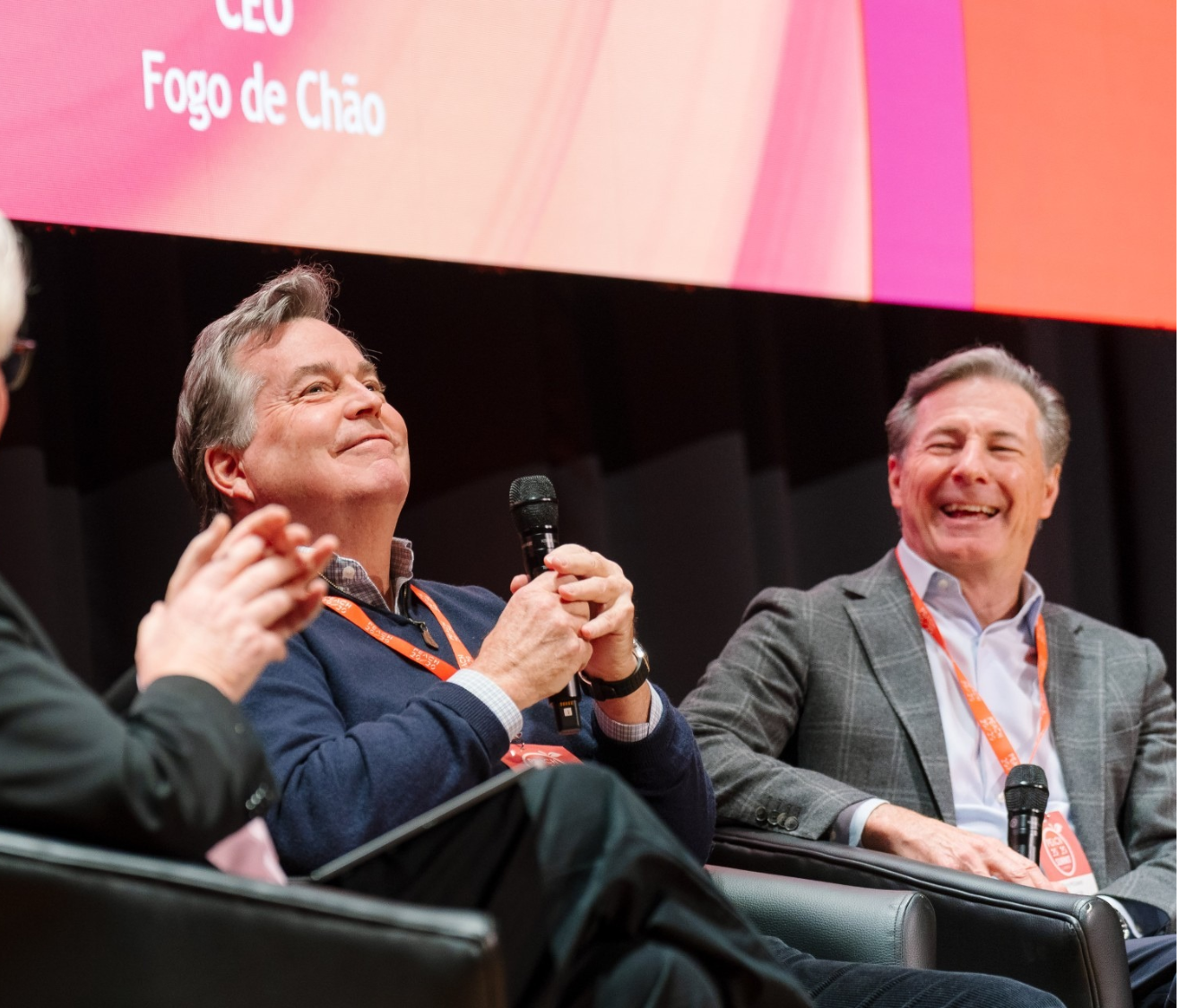
An American who built his business in Europe, a European who built his career in America and two hospitality businesses operating at or approaching billion-dollar scale. The stage was set for one of the most talked-about sessions of the day.
Despite markedly different ownership structures, operating models and entrepreneurial journeys, Ford and McGowan revealed striking similarities in their approaches to building international businesses. What emerged was a compelling argument for patient capital, disciplined expansion and building organisational capability ahead of growth. There was also plenty of humour, candour and evident mutual respect.
Scale the culture before the estate
Caffè Nero has 1,205 coffee houses across 12 countries, all but 50 company-owned, employing some 12,000 people. Perhaps more remarkable is that 100 people have been with Ford for 20 years and 200 for 15 years. “This isn't just my mission. We've done this together,” he said.
At Fogo de Chão, which expects to finish 2026 with 135 restaurants globally, the average general manager has been with the business for ten years. Its regional director has clocked up 36 years.
Both businesses prioritise internal promotion, creating successive layers of entrepreneurial leadership.
McGowan has three years' visibility of his next generation of leadership and two years' visibility of his property pipeline. As McGowan observed, never let your site pipeline get ahead of your talent pipeline.
Global ambition, local intelligence
Neither leader subscribes to a cookie-cutter approach to international expansion. Ford relishes the intellectual and commercial challenge of building a premium global coffee brand that retains its identity while becoming a genuinely local neighbourhood gathering place. The coffee is consistent globally; the food, design and leadership are adapted to local markets.
Behind that entrepreneurial flexibility lies considerable financial rigour. Ford's rule of thumb? Labour and occupancy costs combined should not exceed 50% of sales. And it takes around 40 to 50 coffee houses in a market to start generating meaningful EBITDA after central overheads.
McGowan is similarly forensic about unit economics and the infrastructure required to support growth.
Fogo's acquisition of the Fazenda business in the UK provides a platform for European expansion, while its operation in the Philippines could become the springboard for Asia, while Brazil still remains the heart and soul of the brand.
Knowing which risks to take
“I made a lot of mistakes, so that's where I know what not to do,” acknowledged McGowan. And if things don’t work Ford is diligent in understanding why.
Both leaders are selective about where they deploy capital. For Ford, entering Manhattan would absorb disproportionate management energy when more attractive opportunities exist in its commuter communities.
McGowan's advice to British operators contemplating America? Resist the glamour of Manhattan, Miami and Los Angeles. Look first at markets such as Dallas. Fogo's recent openings in smaller US markets are achieving record sales.
The most prestigious address isn't necessarily the best commercial opportunity.
Capital: oil in the engine
Ford increased Caffè Nero's value five-and-a-half-fold during its six years on the London Stock Exchange, before taking it private in 2007. International expansion began almost immediately.
His amusing account of successive meetings with City fund managers – one urging international expansion, the next vehemently opposing it – illustrated the tension between long-term strategy and short-term investor expectations.
McGowan, now backed by Bain Capital, has a pragmatic view of private equity: “It's oil in the engine to us entrepreneurs.”
Their approaches to ownership differ, but their underlying philosophy is similar: capital must serve the long-term ambitions of the business, not the other way around.
Financial resilience also creates the capacity to be bold. During Covid, while competitors were cutting marketing expenditure, McGowan went to his board asking for $8 million to invest in marketing. He retained his people and pursued every opportunity to generate revenue. “And we screamed out of COVID,” he remembers.
Build a business, not an exit
Ford's advice is to run the business as if you're never going to sell it. Caffè Nero is now 30 years old, and Ford is thinking about the next 30,
McGowan continues to increase his personal equity stake and is already thinking about Fogo's next 50 years. His ambition? A Fogo de Chão in every major capital city in the world.
What united Ford and McGowan was not simply the scale of their ambition, but their understanding of what makes scale sustainable. Both have the appetite to take significant commercial risks, underpinned by a forensic understanding of unit economics, a commitment to developing talent and a determination to protect the integrity of their brands.
Building a billion-dollar hospitality business, it turns out, requires the entrepreneurial instincts to think big and the operational discipline to think small. Or, as McGowan put it: “One restaurant at a time, one shift at a time.”